

Bringing the Past to Life
Experimental Archaeology
For the Society of Historical Studies "Koryvantes," history is not just read, it is experienced. Experimental archaeology is the cornerstone of our methodology, bridging the gap between academic theory and practical reality by testing historical hypotheses through the rigorous reconstruction and use of ancient armor, weapons, and techniques.
Why is this important? Because reading about the Mycenaean Dendra armor or the Macedonian sarissa tells only part of the story. To truly understand ancient warfare, we must feel the weight of the bronze and the balance of the spear. Experimental archaeology turns abstract data into tangible, measurable evidence.
Since 2010, "Koryvantes" has pioneered practical applications of experimental archaeology in Greece. We have continuously tested the realities of ancient Greek warfare, from evaluating the linothorax and reconstructed swords to studying the biomechanics of traditional archery. Through collaborations with academics and international projects—including BBC documentary productions—we validate historical artifacts through hands-on experimentation.
Reconstructing a heavy "Greek type" Arrowhead / An experimental archaeology project
We are happy to see the completion of a collaborative experimental archaeology project of Association #KORYVANTES (Chrysostomos Lambrou / Spyros Bakas ), which aimed to reconstruct a unique arrowhead typology of the ancient world which is considered to be a "Greek type" and of "heavy size". The project was based on a prime example of this typology which is being exhibited in the British Museum and originates from Olynthus (Macedonia).
The typology has been categorised as "1b4" according to Snodgrass, as "IA3" according to Baitinger,as "A2" according to Bellas, and dates between 5th and 4th Century BCE . Geographically its dispersion is small and limited to the Greek and the Magna Grecia region. It was found mainly in residential complexes (Olynthos, Imera, Selinunte) and in sanctuaries (Olympia, Selinunte, Krimisa). Our reconstruction process included sand molded casting, (using Bronze of the "common type" of Ancient Greece: ≈91.5%Cu, 8,5%Sn) and the reconstruction of 15 pieces (Length:14.5 cm, weight:416 g)
The final part of the project was focused on the experimental reconstruction of 5 fully functionable war-arrows (31'', 60-65#spine, 11-32 ⌀ pine wood) which were tested in terms of functionality with a short Scythian Hornbow (55# lbs) and a 75# selfbow (longbow type).The results were quite interesting and proved the lethal impact of such big-size arrowheads in the battlefield of the Ancient Greek world. The authors are willing to present their results in a future academic paper.


Παρουσίαση της Πειραματικής Έρευνας πάνω στην Μακεδονική Σάρισσα στην ΕΡΤ1 | 17/4/2022
Παρουσίαση της Πειραματικής Έρευνας πάνω στην Μακεδονική Σάρισσα στην Τηλεόραση της #ΕΡΤ1 / 17 Απριλίου 2022
--
Την Κυριακή 17 Απριλίου 2022 η ΕΡΤ1 -μέσα απο την εκπομπή του Γιάννη Σκάλκου και της Νίνας Κασιμάτη #ErtSavvatokyriako - φιλοξένησε σε ζωντανή σύνδεση, τον Αρχαιολόγο και μέλος του Συλλόγου μας Σπύρο Μπάκα o οποίος παρουσίασε εν συντομία το Project Πειραματικής Αρχαιολογίας πάνω στην Μακεδονική Σάρισσα το οποίο διοργανώθηκε στην Φλώρινα το διήμερο 16-17/4/2022
Θερμές Ευχαριστίες στον συνεργάτη της ομάδος μας Spiros Fren καθώς και την πολύ δυνατή του Κινηματογραφική ομάδα για την πραγματοποίηση αυτής της παρουσίασης.
Ευχαριστούμε πολύ τα μέλη του Συλλόγου μας Γιάννης Δανδουλάκης Marinos Meimaris Δημήτριος Περσέας Λουκίσσας για την υποστήριξη στην πραγματοποίηση των πειραματισμών.
Περισσότερα για το Πείραμα, εδώ: https://exarc.net/events/experimenting-sarissa
Reconstructing the Macedonian Sarissa: Experimental Archaeology and the Hellenistic Phalanx
---
Three years ago (April 2022), #KORYVANTES Association successfully completed an experimental #archaeology project dedicated to unlocking the mechanics of the #Macedonian #sarissa, the long spear that powered the Macedonian war machine and the #Hellenistic kingdoms from the 4th to the 1st century BC. The field experiment took place at Florina #Greece, under the academic framework and protocols of Experimental Archaeology. It was also included in event calendar of the World Organisation for Experimental Archaeology #EXARC.
Designed and directed by Spyros Bakas (MA, University of Warsaw), the project focused on the functional performance and mechanics of the sarissa as the primary offensive weapon of the Macedonian phalanx, examining key technical questions that have occupied international scholarship for decades. Through a series of controlled trials, the team tested:
The application of the so‑called “small spearhead” and the distinctive polygonal connector, identified by Professor Manolis Andronikos, as potential components of the sarissa based on precise reconstructions of the archaeological finds.
The use of the endemic wood Fraxinus excelsior (ash) as a probable construction material for the shafts, in multiple sarissa lengths: 16 cubits (7.7 m), 12 cubits (5.8 m) and 10 cubits (4.8 m).
The durability, accuracy and handling of the longest 16‑cubit (7.7 m) version, as described by ancient authors such as Polyainos and Polybios.
The combat efficiency of both oblique and upright fighting stances adopted by the bearer of the weapon.
In order to simulate authentic battlefield conditions, the experiment employed historically accurate reconstructed defensive equipment, including various linothorax cuirasses, helmets, and shields, reproducing the weight and movement mechanics of a fully armed phalangite. The results of the project proved highly encouraging and illuminating, allowing the research team to refine its conclusions for forthcoming academic publication and significantly strengthening the culture and practice of Experimental Archaeology in Greece, while contributing original data to the international debate on Hellenistic warfare.


Πειραματική ανακατασκευή βλημάτων Σφενδόνης – Ένα όπλο ψυχολογικού πολέμου των αρχαίων Ελλήνων
Οι #Κορύβαντες παρουσιάζουν με υπερηφάνεια ένα μοναδικό εγχείρημα πειραματικής αρχαιολογίας: την ανακατασκευή αυθεντικών αρχαίων ελληνικών βλημάτων σφενδόνης (4ος-1ος αι. π.Χ.), χαραγμένων με την επιβλητική επιγραφή «ΔΕΞΑΙ» («Πάρε το!»).
Η σφενδόνη υπήρξε ένα από τα πλέον φοβερά και αποτελεσματικά όπλα του αρχαίου ελληνικού κόσμου. Ο συνδυασμός της εξαιρετικής βλητικής δύναμης και της χρήσης μολύβδινου βλήματος προκαλούσε τρομακτικά αποτελέσματα ενάντια στον εχθρό, τόσο σωματικά όσο και ψυχολογικά. Τα βλήματα ταξίδευαν με φονική ταχύτητα και δύναμη, ενώ η ίδια η θέα τους –συχνά στολισμένη με προκλητικές επιγραφές όπως το «ΔΕΞΑΙ»– ενίσχυε την αίσθηση κινδύνου στον αντίπαλο. Η φράση αυτή λειτουργούσε ως εργαλείο ψυχολογικού πολέμου, ως μια μικρή «κραυγή» αποτροπής, που στόχευε να κλονίσει το ηθικό των εχθρών από απόσταση.
Τα συγκεκριμένα βλήματα αποτελούν αποτέλεσμα εξειδικευμένης custom made παραγγελίας ανακατασκευής η οποία εκτελέστηκε από την εταιρεία Res Bellica για λογαριασμό του Συλλόγου μας κατόπιν οδηγιών μας, ενώ η ανακατασκευή τους έγινε με χύτευση μολύβδου σε καλούπια, ακολουθώντας τα μοτίβα αναπαραγωγής της αρχαιότητας. Το πρωτότυπο βλήμα που αποτέλεσε τη βάση για το έργο βρέθηκε στην Αγορά της Αρχαίας Αθήνας και εκτίθεται σήμερα στο Βρετανικό Μουσείο.
Στις εικόνες μας μπορείτε να δείτε τα ιστορικά, πλήρως λειτουργικά βλήματα και τις σφενδόνες απο λινάρι που συμπληρώνουν αυτή τη μαχητική αναπαράσταση.
Χαρακτηριστικά:
Μήκος: 45mm
Βάρος: 143g
Υλικό: Μόλυβδος


Ανακατασκευή Θυρεού της Ελληνιστικής Εποχής (3ος Αιώνας π.Χ)
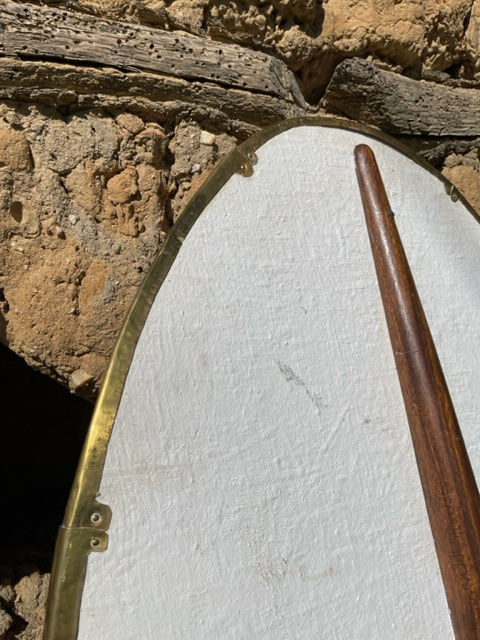
Μια εξαιρετική ανακατασκευή (Battle ready) ασπίδας τύπου "Θυρεός" , βασισμένη σε επιτύμβια στήλη Σελευκίδη Θωρακίτη του 3ου Αιώνα π.Χ., η οποία σήμερα φιλοξενείται στο Μουσείο Κωνσταντινουπόλεως. Οι Θυρεοί χρησιμοποιήθηκαν απο τους ελληνιστικούς στρατούς από τον 3ο αιώνα π.Χ. και έπειτα, ενώ έδωσαν το όνομα τους και στις μονάδες των "Θυρεοφόρων". Η ασπίδα θα χρησιμοποιηθεί σε επικείμενα project του Συλλόγου #ΚΟΡΥΒΑΝΤΕΣ τα οποία θα ανακοινωθούν σύντομα.
Υλικό: Σανίδες ξύλου βελανιδιάς, άξονας καρυδιάς, oρειχάλκινο γείσο, σιδερένιος ομφαλός, λινό, δέρμα, Βάρος: ≈2.7 kg , Ύψος: 1.2 m, Πλάτος: 0.6m
Custom κατασκευή για λογαριασμό του Συλλόγου μας απο την εξαιρετική ομάδα της Res Bellica , την οποία ευχαριστούμε θερμά.


𝗥𝗘𝗖𝗢𝗡𝗦𝗧𝗥𝗨𝗖𝗧𝗜𝗡𝗚 𝟲𝟱 𝗦𝗖𝗬𝗧𝗛𝗜𝗔𝗡 𝗔𝗥𝗥𝗢𝗪𝗛𝗘𝗔𝗗𝗦 (Typology 3Β2 / trilobate barbed socketed / 7th-4th Century BC )
We are proud to see another experimental archaeology project to be implemented by our team. The reconstruction of a very common arrowhead typology of the ancient Greek world which is considered to be a "Scythian" type. It has a trilobate shape, a socket for adjusting the shaft, and a protruding barb which made it dificult to take our and tore up the flesh when they were. The typology has been categorised as "3Β2" according to Snodgrass, as "ΙΙB2" according to Baitinger,as "B2βi" according to Bellas, and dates between 7th and 4th Century BCE .
Even if it considered a Scythian typology, its dispersion is wide among ancient Greek settlements: it was found in sanctuaries (Olympia, Nemea, Kato Fana, Kamiros, Ephesus and Kyrenia), in citadels (Oismi, Lindos), while the earliest examples come from Greek settlements in Asia Minor.
Our reconstruction process included mold casting, (using Bronze of the "common type" of Ancient Greece: ≈91.5%Cu, 8,5%Sn) and the reconstruction of 65 pieces (Length:42 mm, weight:40 grains)


Reconstructing the Byzantine Klivanion
Picking a random piece from the collection of lames found at the Veliki Preslav site (10th c) to re-construct, the result uncovered the full majesty of byzantine military technology. The result of our work, meticulously and faithfully following the archeological find and bio-mechanics of medieval warfare, and unbiased by unreliable artistic depictions, proved a stunning reality.
A) The klivanion is indeed what it's name proclaims: a rigid and fully enclosed "furnace-like" torso jacket, with no weak point at all.
B) The resulting thorax is not heavy and not ugly or clumsy looking, like an unnecessarily baggy coat, as most of the other byzantine lamellars we see around look. Instead it is a beautiful, elegant and anatomical construction, allowing the soldier to acquire the fullest protection while not hindering his agility and mobility in battle. The soldier literally forgets that he wears it while performing all the complex maneuvers and movements that fighting in a medieval warfare requires.
The method, full process and results of our project will be presented in due academic manner with a publication, some time soon.


Η Πανοπλία των Δενδρών μέσα από τη Σύγχρονη Έρευνα
Μυκηναϊκή τεχνολογία υπό το φως της επιστήμης - Η σύγχρονη Mελέτη της Πανοπλίας των Δενδρών φέρνει την ελληνική πειραματική αρχαιολογία στο προσκήνιο.
---
Η συζήτηση γύρω από τις Μυκηναϊκές πανοπλίες αναζωπυρώνεται το τελευταίο διάστημα, προκαλώντας νέο ενδιαφέρον και ερωτήματα. Για μια πλήρως τεκμηριωμένη και επιστημονική προσέγγιση, δείτε τη δημοσιευμενη μελέτη των Katsikis Dimitrios και Spyros Bakas – σχετικά με την λειτουργικότητα/πρακτικότητα της περίφημης Πανοπλίας των “Δενδρών” όπως παρουσιάστηκε τις 21 Νοεμβρίου 2024, στο Μέγαρο Μουσικής Αθηνών στα πλαίσια του 3ου Διεθνούς Συνέδριου Αρχαίας Ελληνική και Βυζαντινής Τεχνολογίας.
Σήμερα, έναν χρόνο μετά τη δημοσίευσή της, με περισσότερες από 18.000 θεάσεις+ μόνο στο Academia.edu, η μελέτη αυτή έχει ξεπεράσει τα ελληνικά σύνορα, προκαλώντας διεθνές ενδιαφέρον και ενεργό διάλογο για τη Μυκηναϊκή τεχνολογία και τον οπλισμό της Ύστερης Εποχής του Χαλκού. Η απήχησή της, μοναδική για ελληνόγλωσση δημοσίευση στον τομέα, επιβεβαιώνει τη σημασία της για τη σύγχρονη έρευνα και την ιστορική αναβίωση.
Η φιλοτέχνηση του θώρακα πραγματοποιήθηκε από τον μεταλλοτεχνίτη Κατσίκη Δημήτριο, με αυστηρά παραδοσιακές μεθόδους σφυρηλάτησης. Μία εργασία που ενώνει την ιστορική έρευνα, την πειραματική αρχαιολογία και την κατασκευαστική εμπειρία, για ένα ολοκληρωμένο επιστημονικό έργο, αναλύοντας σε επιστημονικό επίπεδο όλες τις σχετικές παραμέτρους , τόσο σε θεωρητικό όσο και σε πρακτικό επίπεδο.
Ευχαριστούμε θερμά όλα τα μέλη και συνεργάτες του Συλλόγου που συνέβαλαν στην υλοποίηση αυτής της προσπάθειας.


